
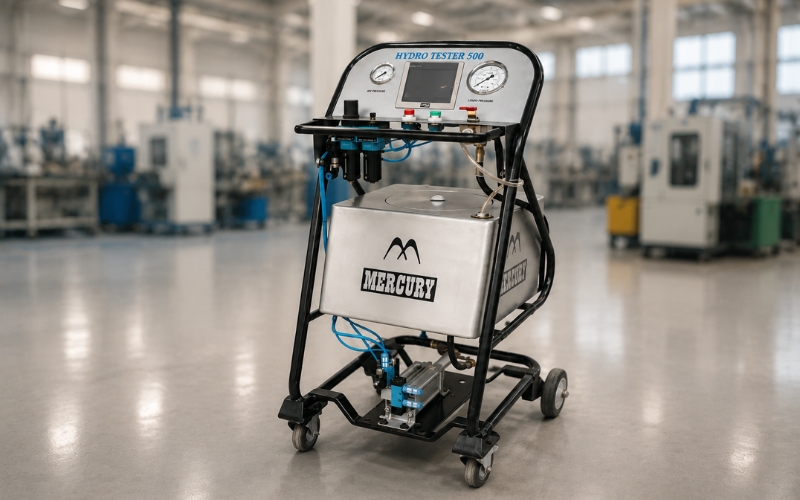
In modern manufacturing, product reliability is everything.
Whether it is:
the biggest question manufacturers must answer is simple:
“Will this component hold pressure safely without leaking?”
That is where hydrotesting becomes critical.
Hydrotesting is one of the safest and most reliable methods used worldwide to test pressure-containing components. By filling a component with water and pressurizing it to a specified pressure, manufacturers can verify whether the part can safely withstand operating conditions.
But generating extremely high hydraulic pressure safely, compactly, and economically is not easy.
This is where Mercury Pneumatics made a major contribution to Indian industry.
Since the 1990s, Mercury Pneumatics has been one of the few Indian manufacturers to indigenously develop high-pressure hydropneumatic pump technology and integrate it into complete hydrotesting systems for industrial applications.
At the heart of every hydrotesting system lies the pressure generation unit.
Mercury’s hydrotesting systems use hydropneumatic pumps based on the equilibrium principle and Pascal’s Law.
The governing relationship is: P1A1=P2A2
This equation explains how pressure and area interact in a confined system.
In simple terms:
If pressure acts on different piston areas, force and pressure can be amplified depending on the area ratio.
This is exactly how hydropneumatic pumps generate extremely high hydraulic pressure using ordinary compressed air.
The pump consists primarily of:
Compressed air acts on the larger piston area. The force generated is transferred to a much smaller hydraulic area. Because the hydraulic area is smaller, pressure intensification occurs. This allows the system to generate extremely high output pressures.
Using this principle, Mercury’s hydropneumatic pumps can generate pressures all the way up to:
using compressed air alone. That is remarkable engineering efficiency.
Traditional hydraulic pressure systems often require:
Hydropneumatic pumps eliminate many of these complexities. They are:
One of their most fascinating characteristics is that they are self-stalling.
Hydropneumatic pumps work on equilibrium. The pump keeps reciprocating and building pressure until the output hydraulic pressure becomes equal to the driving pneumatic force ratio.
At that point:
This means the pump automatically stalls safely once the desired pressure is reached. No additional control complexity is required.
This makes the system extremely reliable and safe.
Because hydropneumatic pumps can operate pneumatically without electrical power at the pressure generation stage, they are highly suitable for:
This becomes a major advantage in industrial safety.
At a time when high-pressure testing systems were heavily dependent on imported technologies, Mercury Pneumatics indigenously developed hydropneumatic pressure intensifier systems in India.
Over time, based on customer requirements, Mercury forward integrated the technology into complete hydrotesting systems.
These systems evolved from simple manual testers into sophisticated semi-automatic and PLC-controlled testing solutions with:
This made high-pressure testing more reliable, repeatable, and operator-friendly.
A hydrotesting machine is a system used to test whether a component can safely hold pressure without leakage. The component is filled with water because water is:
The component is then pressurized to a predetermined pressure and monitored for leakage or pressure drop.
In a basic hydrotesting setup:
The operator observes pressure behavior. If pressure drops:
If pressure holds:
After testing:
This simple process forms the foundation of hydrotesting.
Mercury Pneumatics advanced this process significantly through semi-automatic hydrotesting systems.
In semi-automatic systems:
This dramatically improves:
The process typically works as follows:
The operator connects the component to the testing fixture.
Through the PLC-HMI system, the operator can set:
This allows precise testing standards.
When the start button is pressed:
Pressure is continuously monitored through pressure transducers.
As soon as the preset pressure is achieved:
Now the component enters the actual leak testing phase.
The pressure transducer continuously monitors pressure inside the component. If pressure remains within the acceptable range for the specified testing time:
If pressure drops below the permissible limit:
This process eliminates human judgment errors and ensures consistent quality control.
After testing:
Modern industries increasingly demand traceability and validation records. Mercury’s semi-automatic hydrotesting systems can also include:
The system can generate reports containing:
This becomes extremely valuable for:
Hydrotesting systems are used across multiple industries including:
Wherever pressure containment matters, hydrotesting becomes essential.
Mercury’s hydrotesting systems can be used for testing:
Essentially, any component designed to contain fluid pressure can be hydrotested.
Modern manufacturing demands:
Semi-automatic hydrotesters solve all these requirements.
Compared to manual testing:
That is why industries are increasingly shifting toward automated testing systems.
Hydrotesting is a pressure testing method where water is used to pressurize a component to check for leakage or structural integrity.
Water is nearly incompressible and much safer than compressed gas during testing failures.
A hydropneumatic pump uses compressed air to generate extremely high hydraulic pressure through pressure intensification principles.
Depending on the model and application, pressures up to 2,000 bar can be generated.
Industries such as automotive, oil & gas, aerospace, plumbing, valve manufacturing, hydraulic systems, and pressure vessel manufacturing widely use hydrotesting.
Semi-automatic systems improve repeatability, reduce operator dependency, automate testing cycles, and provide digital traceability.
A pressure drop indicates leakage or failure in the component being tested.
Yes. Advanced PLC-HMI systems can provide data logging, traceability, and printouts of testing results.
Yes. They use compressed air efficiently and consume energy only during operation.
Yes. Pneumatically driven hydropneumatic systems are suitable for hazardous environments because they can operate with minimal electrical risk.
WhatsApp us