
In the world of industrial manufacturing, one challenge has remained constant for decades:
How do you generate very high force efficiently, accurately, safely, and economically?
Traditional mechanical presses solved this problem through brute mechanical motion. Hydraulic systems solved it through oil pressure. Pneumatic systems solved it through speed and simplicity.
But manufacturers around the world eventually realized something important:
Industry needed something in between.
That is exactly why hydropneumatic technology was invented. And in India, one of the pioneers of this technology was Mercury Pneumatics, which indigenously developed hydropneumatic systems in 1987–1989 using a remarkably elegant engineering principle based on one of physics’ most fundamental laws: Pascal’s Law.
Imagine a factory assembling staplers, automotive components, bearings, electrical terminals, or metal inserts. The application may require:
A simple pneumatic cylinder may not generate enough force.
A hydraulic press may generate excessive force, consume more power, require hydraulic power packs, create leakage risks, and increase maintenance.
A mechanical press may deliver force only at fixed positions in its stroke.
So engineers asked a brilliant question:
“Can compressed air be intelligently amplified to create hydraulic-level force — without needing a full hydraulic system?”
That question led to hydropneumatics.
At the heart of hydropneumatics lies a very simple physics principle known as Pascal’s Law. The law states:
P1A1 = P2A2
Where:
In simple terms: Pressure applied to a confined fluid gets transmitted equally in all directions.
This means that if you reduce the area on one side while maintaining pressure equilibrium, force multiplication occurs.
And that is the magic behind hydropneumatic systems.
Physics becomes easier when we visualize it in everyday life. Imagine a door that can swing both inward and outward. Now imagine:
Three things can happen:
The door moves inward.
The door moves outward.
The door stays exactly where it is. That balanced condition is called equilibrium.
Hydropneumatic systems work on a very similar principle.
The pneumatic side continuously generates force. The hydraulic intensifier amplifies it. The ram keeps moving and generating pressing force until it encounters an equal reaction force from the component being pressed. Only then does equilibrium occur and motion stop.
This is one of the most important differences between hydropneumatic systems and mechanical presses.
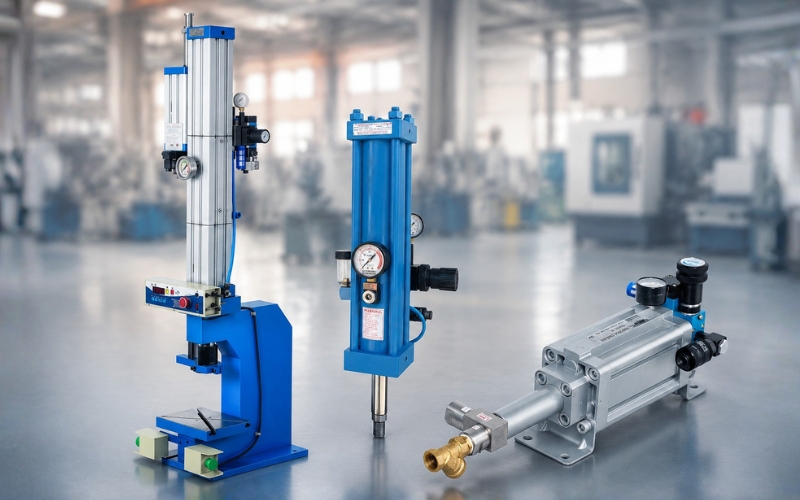
A hydropneumatic press combines:
The system typically consists of:
Compressed air acts on a larger pneumatic piston. That force is transferred through hydraulic oil onto a much smaller hydraulic piston area. Because the hydraulic area is smaller, the output force becomes dramatically higher.
This is pure applied physics. No complicated electronics. No massive hydraulic power pack. No continuously running hydraulic motor. Just intelligent use of force equilibrium and area ratios.
Hydropneumatics became popular because it solved multiple industrial problems simultaneously.
Factories already had compressed air available. Hydropneumatic systems used this existing infrastructure to generate forces many times greater than normal pneumatic cylinders. This reduced dependence on bulky hydraulic systems.
Traditional hydraulic systems often run continuously. Even when no pressing operation is happening:
Hydropneumatic systems consume energy only during the pressing cycle. This dramatically reduces power consumption. In today’s manufacturing environment where energy efficiency matters more than ever, this becomes a major advantage.
Full hydraulic systems can involve:
Hydropneumatic systems use very small oil volumes in closed circuits. This makes them:
This is where hydropneumatics truly stand apart. Mechanical presses operate through crank mechanisms. That means force generation depends on crank position. Maximum force is available only near:
This creates limitations. If the component height changes slightly, or if force is required midway through the stroke, the system becomes less flexible.
Hydropneumatic systems work differently. They do not depend on crank geometry. They generate force based on equilibrium. So:
This gives enormous flexibility. The ram continues pressing until the required reaction force is achieved. That means:
This is why hydropneumatic presses became extremely successful for precision assembly applications.
Today, hydropneumatic technology is used in:
In many of these applications, manufacturers need:
Hydropneumatics delivers all four.
From an engineering standpoint, hydropneumatic systems are elegant because they combine:
Unlike purely hydraulic systems, they do not require large infrastructure. Unlike mechanical systems, they are not constrained by rigid kinematics. Unlike simple pneumatic systems, they can generate extremely high force. They sit perfectly between the three technologies. That is why many engineers consider hydropneumatics one of the smartest examples of applied industrial physics.
In the late 1980s, Indian manufacturing was evolving rapidly. Industries needed better pressing solutions, but imported systems were expensive and often unsuitable for Indian operating conditions.
Recognizing this gap, Mercury Pneumatics indigenously developed hydropneumatic technology around 1987–1989. This was not merely a copied system. It was an engineering-driven innovation rooted in understanding:
At a time when advanced industrial automation technologies were not easily accessible in India, Mercury helped bring high-force precision pressing solutions to Indian manufacturers. Over the decades, hydropneumatic presses developed by Mercury have been used across industries ranging from automotive and electrical manufacturing to consumer products and industrial assembly.
One of the most fascinating aspects of hydropneumatics is that the system naturally seeks equilibrium. The ram keeps moving because the generated force is greater than the opposing force. As resistance increases during pressing:
Finally:
At that instant, equilibrium is achieved. Motion stops. This self-balancing characteristic allows hydropneumatic systems to apply highly controlled force without relying entirely on rigid mechanical positioning. That is why the technology performs exceptionally well in delicate assembly applications where excessive force can damage components.
Even in the age of servo presses and advanced automation, hydropneumatic systems remain highly relevant.
Why?
Because manufacturing still values:
Hydropneumatics delivers all of these. And in many mid-range industrial applications, it remains one of the most practical and economical technologies available.
Hydropneumatic technology is a perfect example of how elegant engineering often comes from understanding basic physics deeply. By intelligently applying Pascal’s Law and equilibrium principles, engineers created a system capable of converting ordinary compressed air into powerful, controllable pressing force.
It bridged the gap between:
And decades later, it continues to power industries around the world. Perhaps the most beautiful aspect of hydropneumatics is this:
It does not rely on brute force alone. It relies on balance. On equilibrium. On understanding how forces interact. And that is what makes it not only an industrial solution — but also a brilliant piece of applied physics.
WhatsApp us