
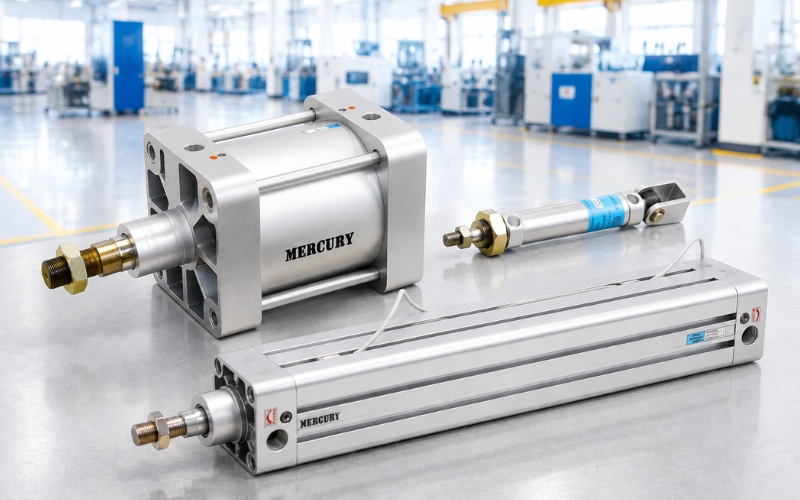
Walk into almost any modern factory and you will find one component working quietly in the background of nearly every automatic machine:
The pneumatic cylinder.
Whether it is:
pneumatic cylinders are everywhere.
Why?
Because they are one of the simplest, most economical, fastest, and most reliable ways to generate linear motion in industrial automation.
At first glance, a pneumatic cylinder may look like a simple metal tube with a rod moving in and out. But behind this simple appearance lies a beautiful application of basic physics.
And the fascinating part is this:
A pneumatic cylinder converts invisible compressed air into powerful mechanical movement using one of the simplest engineering relationships ever discovered.
The working principle of a pneumatic cylinder is based on a very simple force equation:
F = P × A
Where:
This equation is the foundation of pneumatic automation.
In simple language:
When compressed air pressure acts on a surface area, it generates force.
The larger the piston area, the greater the force produced.
Imagine you are pushing a small pin using your finger. Now imagine pushing a large flat board with the same effort.
The larger surface distributes force differently and creates greater overall impact.
That is exactly how pneumatic cylinders work.
Inside the cylinder is a piston. Compressed air enters the cylinder and pushes against the piston surface. Because the piston has area, pressure converts into force. That force then moves the piston rod forward or backward.
Simple physics. Powerful results.
This surprises many people. Even ordinary factory air pressure can generate very high force.
Let us understand with a simple example:
Suppose:
Then:
F = 5 × 10 = 50 kgf
That means the cylinder can generate approximately 50 kilograms of force.
Now imagine larger bore cylinders with bigger piston areas. The forces become substantial enough for:
This is why pneumatic cylinders became the backbone of industrial automation.
A pneumatic cylinder mainly consists of:
Compressed air enters through ports in the cylinder. Depending on which side receives air pressure:
The movement is linear, smooth, and repeatable. The motion can then be used to automate industrial tasks.
One of the biggest advantages of pneumatic systems is how easily they can be controlled.
The cylinder itself is the actuator. But the brain behind its movement is usually a solenoid valve.
A solenoid valve is an electrically operated directional control valve.
Using a simple electrical signal from:
the valve changes airflow direction. As a result:
This makes pneumatic automation extremely easy to integrate into automatic machinery. In simple words:
A tiny electrical signal can control a very large mechanical movement. That is incredibly powerful in automation engineering.
There are many motion technologies available today:
Yet pneumatic cylinders remain one of the most widely used automation components in the world. Why?
Because they offer an exceptional balance of:
Let us understand these advantages one by one.
Most industries already have compressed air systems installed. That means pneumatic cylinders can operate using existing infrastructure.
No separate power source is needed for each actuator. This makes implementation economical and practical.
Pneumatic cylinders are relatively lightweight compared to hydraulic systems. They are compact and easy to mount on machines.
This allows machine designers to create:
One of the biggest strengths of pneumatics is speed. Air moves quickly. As a result, pneumatic cylinders can achieve very fast extension and retraction speeds.
This is why they are ideal for:
Where high cycle rates matter.
Pneumatic systems are mechanically simple. There are:
In most cases, maintenance involves:
That is why pneumatic systems are known for long operational life.
Pneumatic cylinders are among the most cost-effective actuators available.
Compared to servo systems or hydraulic systems:
This makes them especially attractive for:
Because pneumatic cylinders have relatively simple construction and low friction operation, they often provide excellent life expectancy.
Modern cylinders can perform millions of cycles when operated under proper conditions. That reliability is critical in industrial automation.
Unlike hydraulic systems:
This makes pneumatic systems ideal for industries such as:
Where cleanliness matters.
Another major reason for the popularity of pneumatic cylinders is global standardization.
Most reputable pneumatic cylinder manufacturers follow internationally accepted ISO standards.
This means:
For machine builders and factories, this is a huge advantage. A cylinder from one ISO-standard manufacturer can often be replaced with another compatible brand available anywhere in the world. This reduces downtime and simplifies procurement.
Even with the rise of electric automation, pneumatics remain dominant in many industries.
Why?
Because many industrial applications do not require:
They simply need:
Pneumatic cylinders do this exceptionally well. That is why they continue to power millions of machines globally.
Today pneumatic cylinders are used in:
In many factories, thousands of pneumatic cylinders operate simultaneously every day. Quietly. Reliably. Efficiently.
Perhaps the most remarkable thing about pneumatic cylinders is their simplicity.
No complicated mechanisms. No sophisticated physics. Just compressed air, pressure, area, and motion.
Yet this simple principle transformed industrial automation worldwide. By using the basic equation:
F = P × A
Engineers created one of the most practical and economical motion technologies ever developed.
And decades later, pneumatic cylinders remain the preferred choice for automation because they continue to deliver what industries value most:
Sometimes, the most successful engineering solutions are not the most complicated ones. They are simply the ones that work brilliantly, every single day.
WhatsApp us