
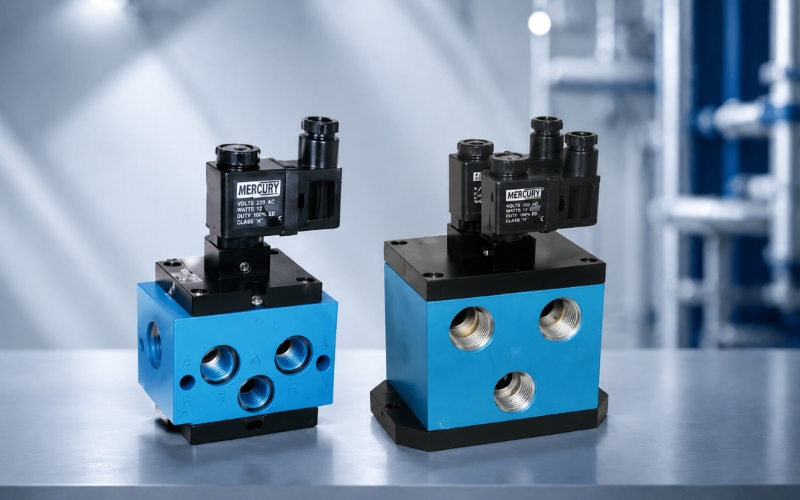
Precise motion control is essential in modern pneumatic automation. While many applications require a cylinder to fully extend or retract, some processes demand the piston to stop at an intermediate position. This is commonly achieved using a 5/3 Pressure Centre Directional Control Valve.
Unlike a standard 5/2 valve, a 5/3 pressure centre valve features a third spool position that allows the cylinder to hold its position by applying equal pressure to both sides of the piston.
A 5/3 valve is a directional control valve with:
The three positions are:
The centre position is what makes this valve ideal for applications requiring intermediate cylinder positioning.
When the valve shifts to its pressure centre position, compressed air is supplied equally to both cylinder ports.
Since both sides of the piston receive equal pressure, the forces become balanced. This helps the piston remain in its current position instead of extending or retracting.
This feature provides better control in automation processes where temporary positioning is required.
A 5/2 directional control valve has only two operating positions:
It cannot hold the cylinder at an intermediate position because it always directs air to move the piston in one direction.
A 3/2 valve is primarily designed for single-acting cylinders, where air pressure moves the piston in one direction, and a spring returns it.
Since double-acting cylinders require air supply to both ports, a 3/2 valve is not suitable for mid-stroke positioning.
5/3 Pressure Centre Valves are widely used in:
Mercury Pneumatics offers high-quality pneumatic directional control valves engineered for reliable performance, smooth operation, and long service life. Their pneumatic solutions are designed to meet the demands of modern industrial automation.
When an application requires a pneumatic cylinder to stop at an intermediate position, the 5/3 Pressure Centre Valve is the preferred solution. By applying equal pressure to both sides of the piston, it balances the forces and helps hold the cylinder in position, making it ideal for precision automation and controlled motion.
A pneumatic directional control valve with five ports and three spool positions that can hold a double-acting cylinder at an intermediate position.
A 5/3 valve has a centre position that helps hold the cylinder in place, while a 5/2 valve only extends or retracts the cylinder.
No. A 3/2 valve is mainly designed for single-acting cylinders.
They are commonly used in automation systems, packaging machines, assembly lines, material handling equipment, and pneumatic control systems.
It allows a double-acting cylinder to stop and hold at an intermediate position for improved control and accuracy.
WhatsApp us